
What your kid actually learns
The hardest thing about kids' sport is that improvement is invisible. Your child comes home sweaty and happy, and three months later you still don't know whether anything was built. We won't do that to you — here is exactly how progress is measured, and exactly what you get in writing.
The shots
Everything has a name
Badminton isn't one skill, it's a handful of named shots — clearing, netting, lifting, smashing, dropping, driving, blocking and the net kill — plus two footwork ladders underneath them. Your child will learn to name them too, which is the first sign a kid has actually been coached rather than just supervised.
Each shot breaks down further into the movements that make it work: how you hold the racquet, where your feet are, what your elbow does, when you turn. We've written those lists down for every shot we teach, and the first item on every single one is the same — hold the racquet correctly. Almost everything a beginner struggles with traces back to it.
So when a coach says your child is "working on their clear", they mean something specific: which piece of the clear, and what has to happen before the next piece gets added.
All of it is published. Every ladder, every drill, in order — see the full progression roadmap. This page is the companion to it: the roadmap is what your child works through, and this is how we decide they're done with a rung.
The grading
How we measure a skill: 0% to 100%
Every named skill is graded on the same scale, and the numbers are not vibes. The whole scale is really one question — how much reminding does this still take?
- 0%The coach reminds them every rep and it isn't going in yet
- 25%Constant reminders, occasionally getting it right
- 50%Does it every time — but only because they're reminded every time
- 75%Doing it on their own most of the time; reminders are getting rare
- 100%The coach says nothing and your child does it correctly, every time
The half of the scale most programs skip is 50% to 100% — the stretch where a skill goes from "does it when told" to "does it without thinking". That's the half that decides whether the skill is still there in six months, and it's why coaches keep working something that already looks fine to a parent watching from the side.
The ladder
Levels are earned one shot at a time
Your child doesn't have a single overall grade. They have a level in each shot — Clearing Level 1, then Clearing Level 2, and the same ladder for netting, lifting and the rest. It's normal, and completely fine, to be further along in one shot than another.
Earning a level
A child earns Clearing Level 1 when the specific elements of that level are all sitting at the right point on the 0–100% scale. It isn't a coach's gut feel on the day — it's the same elements, watched every week, by whoever is coaching.
Moving up
Clearing Level 2 means those first elements are now reliable and a new element has been added on top. The ladder only ever moves when the rung below it holds weight.
Marking the moment
Levels are recognised properly — a medal or certificate, handed over in front of the group. For a child who has never won a sports award before, that is not a small thing.
The level map
This is the same view you get on your child's report. Hover or tap any ladder name, or any level number, for what it means.
| Ladder | ||||
|---|---|---|---|---|
| Clearing Level 1 | Clearing Level 2 | Clearing Level 3 | Clearing Level 4 | |
| Netting Level 1 | Netting Level 2 | Netting Level 3 | Netting has no Level 4 | |
| Smashing does not start until Level 2 | Smashing Level 2 | Smashing Level 3 | Smashing Level 4 | |
| Dropping does not start until Level 2 | Dropping Level 2 | Dropping Level 3 | Dropping Level 4 | |
| Lifting Level 1 | Lifting Level 2 | Lifting Level 3 | Lifting has no Level 4 | |
| Driving Level 1 | Driving Level 2 | Driving Level 3 | Driving has no Level 4 | |
| Block Level 1 | Block Level 2 | Block Level 3 | Block Level 4 | |
| Net kill Level 1 | Net kill Level 2 | Net kill Level 3 | Net kill Level 4 | |
| Back court Level 1 | Back court Level 2 | Back court Level 3 | Back court has no Level 4 | |
| Front and mid court Level 1 | Front and mid court Level 2 | Front and mid court has no Level 3 | Front and mid court has no Level 4 |
Nine ladders, graded separately. Being Level 3 at clearing and Level 1 at netting is normal — that's the point of grading them one at a time.
Level 1 — getting the shape right. How to hold the racquet, what a correct swing feels like, and how to move without tangling their feet. Shuttles are fed gently, from close range, standing still. Every beginner starts here and there is nothing behind it.
Level 2 — adding the feet. The swing is recognisable, so now it gets attached to movement: start in the middle, move to the shuttle, hit, recover. Smashing and dropping are introduced here.
Level 3 — not knowing what's coming. Feeds go anywhere, in no order, so the shot has to survive surprise. This is the level most self-taught players stall at.
Level 4 — continuous and match-like. Rallies that don't stop, against a real opponent. The shot has to hold up under fatigue and pressure, not just in a drill. Only the overhead ladders go this far.
Clearing — the overhead shot to the back of the court. It's the first full swing most kids learn, and it has the longest ladder of the ten because everything else overhead is built on top of it.
Netting — the delicate shot played just over the net. It starts on day one, because it teaches touch rather than power, and a beginner can succeed at it immediately.
Smashing — the attacking shot, hit steeply downward. It starts at Level 2, not Level 1: a child needs a recognisable swing before we add speed to it.
Dropping — the overhead that lands short and soft. Also starts at Level 2, because it's the clearing swing disguised, and the disguise only works once the swing is real.
Lifting — the underarm shot that sends the shuttle from the net all the way to the back. The defensive answer to a smash.
Driving — the fast, flat exchange. This is what rallies turn into once kids get quick, and it's usually the first thing that looks like real badminton to a parent watching.
Block — the soft defensive reply that takes the pace off a smash and drops it at the net. The shot that turns being under attack back into a rally.
Net kill — the sharp downward put-away from a loose shot at the net. Short, and the fastest way a rally ends once kids can spot the chance.
Back court — footwork: moving backwards under the shuttle without losing balance. The hardest movement in the sport for a beginner, and the one most kids avoid.
Front & mid court — footwork: moving forward and side to side. The shortest ladder of the ten, and the one that makes everything else reachable.
The first ten weeks
What progress usually looks like
This is deliberately written as a general plan, not an age-banded one. A seven-year-old can absorb mechanics faster than a thirteen-year-old, and the reverse happens just as often. It's also deliberately conservative — this is what we hold ourselves to, not the best case. Most kids do better.
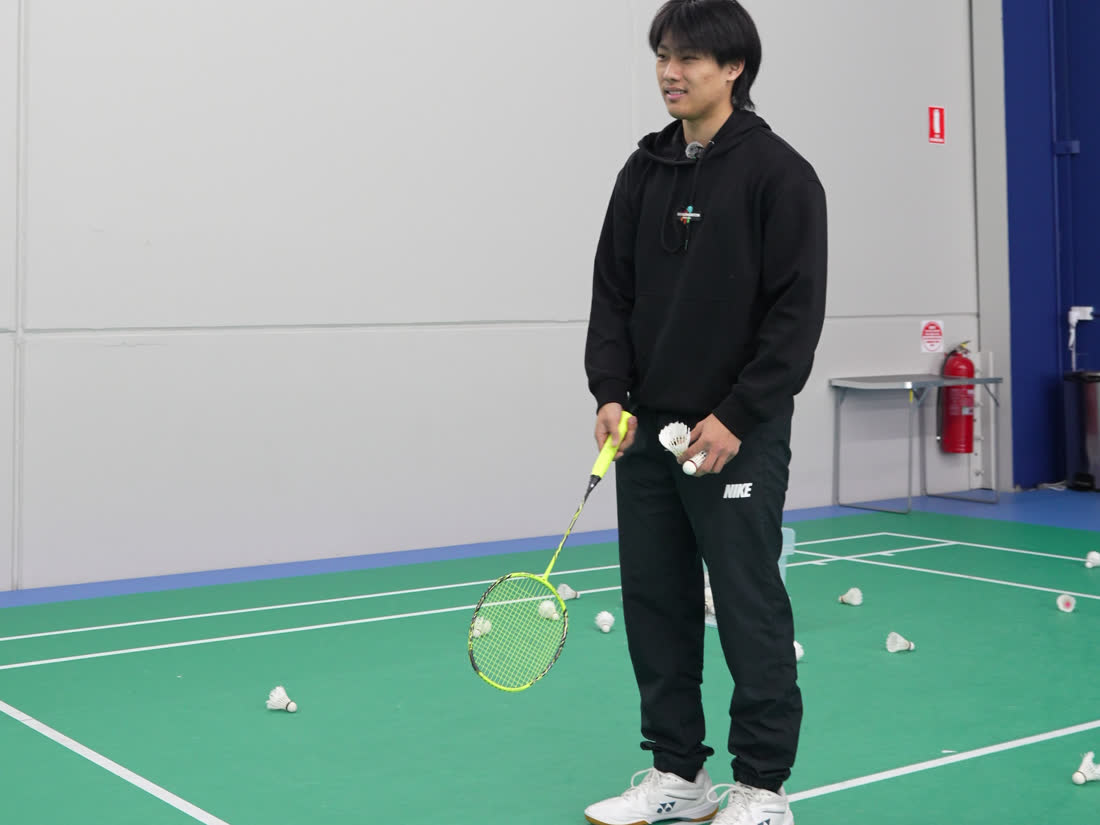
- Week 1 — the trialThe coach reads where your child is starting: front-court and back-court skills, form, footwork, and safety. No level is earned this week; we're finding the starting line.
- Week 3 — they look like a playerThey know how to hold the racquet, know the basics of lunging, and have a recognisable overhead and underhand swing. They may not connect with the shuttle consistently yet — that takes longer — but the shape is already there.
- Week 5 — a coached swing, and a first levelThe swing now genuinely looks trained. Most children can hit an overhead clear fairly consistently and have earned Clearing Level 1, or are well into earning it.
- Week 10 — the season reportTypically two named levels earned, specific elements sitting reliably, and a written report on where they are, what they're working on, and what the next ten weeks should focus on.
What reaches you
You get this in writing
- Every weekThe coach files a lesson report on the group — what was practised, what each child hit, who moved up. Ask any time to see your child's row.
- Every ten weeksA written season report: levels earned, what they now do reliably, what's still being built, and a focus for the next block.
- Any time in betweenJust ask. No meeting, no charge — a coach replies in writing.
And you're never stuck with paperwork. Every single session you can talk to the coach who took your child that day, and to the manager running the floor — two people, every week, who can tell you how it's going without an appointment.
What we can't promise
We can't promise a tournament player in ten weeks, and we can't promise the rate — some children click in week two, some in week seven. The level system surfaces real progress; it doesn't manufacture progress that isn't there.
What we do promise is this: at week ten you will know exactly what your child has and hasn't achieved, in named units, measured the same way as every other child here. No black box.
We'll place your child on the ladder in their free trial.
You'll leave the first class knowing where they're starting and what they'd be working on. That costs nothing.